

The Great Salt Lake: A Solvable Crisis at a Breaking Point
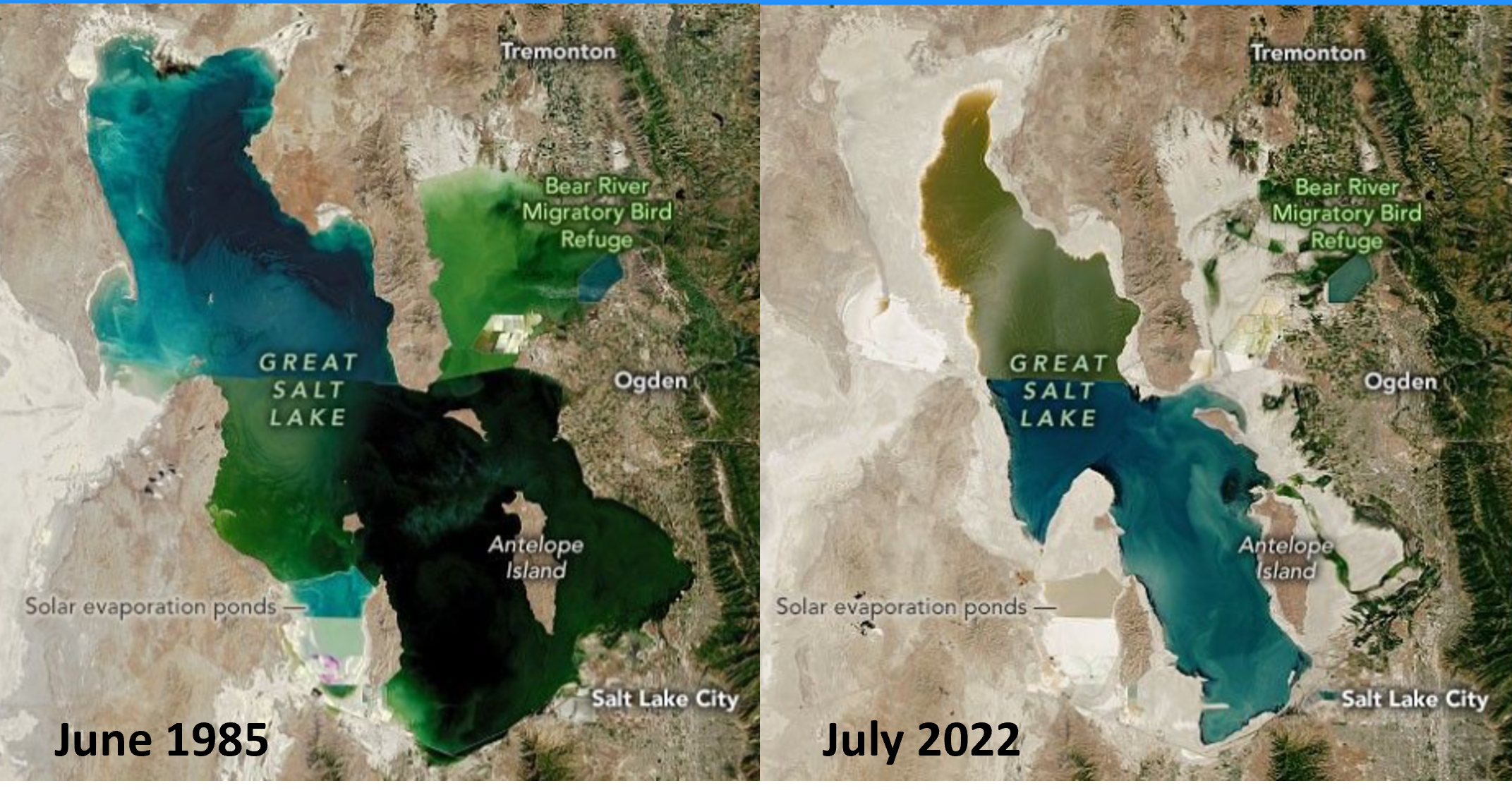
Source: NASA
The Great Salt Lake (GSL) is in structural decline - with consequences for public health, the regional economy, and a globally significant ecosystem. It has already lost more than half its volume and continues to shrink.
This is not a typical water scarcity problem. The standard playbook of efficiency, reuse, and desalination don’t apply.
The Great Salt Lake is a terminal lake: water flows in, but it does not flow out. The only exit is evaporation. As a result, what matters is that the amount of water that ultimately reaches the lake must equal evaporative losses – and today that balance is broken.
The lake faces an annual inflow deficit of roughly 800,000-1,000,000 acre-feet - enough water to supply a U.S. city of 4-5 million people. Closing that gap requires reducing upstream consumptive use at scale.
No society has ever reversed the collapse of a terminal lake. Utah has a narrow window to be the first, particularly as Salt Lake City prepares to host the 2034 Winter Olympics. The problem is solvable.
The science is clear, impacts are measurable, the targets are defined, and the policy tools are emerging. But the lake is near historic lows as snowpack is minimal. 2026 will be a defining year.
The Great Salt Lake Is Approaching a Breaking Point
The Great Salt Lake (GSL) is a terminal lake: water flows in, but it does not flow out. The only exit is evaporation. At the end of 2025, the lake stood at 4,191 feet above sea level - the third lowest level in the modern record and deep into the “serious adverse effects” range, and over 800 square miles of lakebed are currently exposed. Since settlement, the GSL has lost 63% of its volume and 53% of its surface area.
We have seen this movie before. Owens Lake in California was drained to supply Los Angeles; the exposed lakebed became one of the largest sources of PM10 dust pollution in the United States, forcing decades of mitigation costing billions. The Aral Sea followed a similar trajectory, with severe ecological collapse and public health consequences. Terminal lakes do not decline quietly.
The GSL naturally fluctuates - the problem is that we now have a structural imbalance: inflows have declined while evaporation rises. When snowpack in the Bear, Weber, and Jordan river basins is low, the deficit compounds. With the lake already depleted and snowpack this winter well under average, the coming runoff cycle could result in a lake level approaching, or even dropping below, the record low level set in 2022.
The impacts of a shrinking GSL are many and severe:
1) Air quality and public health. Exposed lakebed generates fine particulate matter (PM2.5 and PM10), carrying arsenic and heavy metals. Dust events degrade air quality along the Wasatch Front, increase respiratory risk, and diminish visibility and quality of life.
2) Snowpack and skiing. Dust darkens mountain snow, accelerating melt and already shortening the ski seasons by about 2 weeks. The lake also contributes roughly 5-10% of Wasatch snowfall through lake-effect storms.
3) Salinity increase. As volume declines, salt concentrates. The South Arm is ~14% salinity; the North Arm, which is separated by a causeway, is effectively saturated at ~26%. Further increases threaten the brine shrimp ecosystem in the South Arm, which will collapse around 18–19% salinity.
4) Ecosystem stability. The lake supports a globally significant migratory bird corridor and a brine shrimp-based food web valued at roughly $100M annually. An estimated 10-12 million migratory birds rely on the lake as a critical refueling stop in the Great Basin.
5) Economy & culture. The GSL underpins roughly $2B per year in direct economic activity (minerals, brine shrimp, recreation), alongside Utah’s ski industry of similar scale. It shapes the region environmentally, economically, and culturally. If the lake fails, billions of dollars of infrastructure and the region’s identity stand in harm’s way.
The Great Salt Lake is embedded in the region’s ecological, economic, and climatic DNA. If its decline continues, Utah will have created for itself a public health, biodiversity, and economic crisis that threatens its identity and its future.
Why the Usual Water-Scarcity Playbook Doesn’t Work for the Great Salt Lake
For most water scarcity challenges, improving efficiency and developing alternative sources such as reuse and desalination are standard solutions. But inland terminal lakes operate on a different hydrological reality. Climate variability and warmer temperatures contribute to the problem, but the dominant driver of the Great Salt Lake’s decline is upstream consumptive water use that prevents water from reaching the lake. This is best understood as an end-of-system scarcity problem - water still enters the basin, but too little ultimately reaches the lake.
For the Great Salt Lake to stay in balance, inflows must offset annual evaporation losses. Right now, the gap is about 800,000 to 1,000,000 acre-feet per year: inflows would need to rise about 50%, from ~1,665 KAF/yr to ~2,500 KAF/yr, to reach minimum healthy elevation targets. For scale, 800,000 acre-feet is on the order of the annual municipal water use of a 4–5 million person U.S. city.
Closing this gap is not primarily a technological challenge. The hydrology is well understood, and the deficit is clear. The core challenge is institutional and economic: reducing upstream consumptive use while maintaining viable agricultural economies and functioning water rights systems.
Agriculture, municipal use, and mineral extraction account for 65%, 26%, and 6% of basin water depletions respectively, with the remaining ~3% from upstream evaporation.
According to estimates, irrigated agriculture (especially alfalfa) accounts for ~93% of Bear River withdrawals, ~62% of Weber, and ~55% of Jordan. Much of that water is lost through evapotranspiration - evaporated from soil or transpired by plants.
Municipal withdrawals are different: Utah’s drinking-water systems withdraw ~500–600 KAF/yr, but most of that water returns to the rivers as treated effluent and ultimately flows back toward the lake. By contrast, irrigation diverts water from its path to the GSL.
This is why reuse and efficiency - critical tools in many water-scarce regions - can be counterintuitive here. If such initiatives convert return flows into new consumptive uses, they can actually reduce net inflow to the lake. Utah must focus on reducing net consumptive use upstream.
Current thinking suggests that a little more than half of the needed reductions may ultimately come from agriculture, with the remainder coming from municipal conservation - particularly reductions in outdoor landscape irrigation and pricing reforms that incentivize lower consumptive use.
In practice, this means compensating reductions in irrigation. Farmers could be paid to temporarily fallow fields, shift crops, or lease water rights so that water remains in the rivers and ultimately reaches the lake - while farmers retain their underlying water rights.
In many western basins, compensated irrigation reductions are often the lowest-cost way to generate additional water supply. Early estimates suggest that leasing enough agricultural water to materially increase inflows could require on the order of $100-$200 million per year - significant, but modest relative to the economic risks of continued lake decline.
Similar compensated fallowing programs already operate elsewhere in the western United States, including the Colorado River Basin. Funding could come from state appropriations, municipal water utilities seeking drought resilience, or private-sector “water benefit” programs in which companies, including the large tech companies, fund verified reductions in agricultural water consumption.
Water rights are a central institutional constraint. Utah operates under prior appropriation: water rights are tied to “beneficial use,” and traditional “use it or lose it” dynamics have discouraged voluntary reductions. A farmer who voluntarily uses less may fear forfeiture - and conserved water can still be re-diverted before reaching the lake.
Utah has begun modernizing this framework: H.B. 33 (2022) created pathways to dedicate or lease conserved water toward the GSL without forfeiture risk, and proposals such as H.B. 296 would further align conservation planning with lake inflows. Closing the gap will require scaling these legal delivery mechanisms.
Start-ups and water tech innovation still can play a role, but they must enable execution. For example, in reducing agricultural consumptive use, structuring leasing and fallowing, improving MRV, reducing outdoor irrigation, and ensuring conserved water actually reaches the lake.
Will Utah Save the Great Salt Lake in Time?
Utah has made legislative progress since 2022: instream flow protections (H.B. 33), the creation of the Great Salt Lake Commissioner’s office (H.B. 491), and distribution management planning authority (H.B. 453) built an initial legal foundation with an additional array of bills now under consideration. Nearly 400 K acre-feet (KAF) of additional water has been dedicated or delivered toward the lake since 2022. But flows must increase by at 800-1000 KAF/yr to close the gap.
Momentum around the Great Salt Lake has grown significantly since the Rendezvous event in June. Public awareness has increased, new coalitions have formed, and policymakers have begun committing to restoration targets. The challenge is execution: translating this momentum into measurable policies and programs that increase the water reaching the lake.
The Great Salt Lake Commissioner operates within political constraints, advancing ideas that could generate roughly 200 KAF/yr - because that is what is currently feasible.
But the lake does not respond to what is politically feasible. It responds to flow.
Reducing consumptive water use at scale is unavoidable. Agriculture - particularly irrigated crops such as alfalfa, which is primarily grown as livestock feed - is the dominant consumptive lever in the basin. More aggressive reduction of municipal use can also be part of the solution: residential lawn watering alone consumed roughly 408 KAF in 2024 - roughly half the gap to be closed.
Utah’s turf replacement program has been in operation since 2023, but remains modestly funded and has had minimal impact - significantly greater funding is needed.
No single intervention can deliver the full change needed. The solution is a portfolio of approaches that reduce consumptive depletion and ensure that conserved water actually reaches the lake. For example:
1) Voluntary, compensated agricultural reductions - primarily through leasing water rights, split-season leasing, rotational fallowing, and other mechanisms that reduce irrigation while allowing farmers to retain their underlying rights. These programs would require reliable funding streams - likely a combination of state funding, municipal water agencies, and potentially corporate water benefit programs.
2) Water rights reform and shepherding. “Use it or lose it” incentives and downstream re-diversion mean conserved water must be legally protected and physically delivered.
3) Outdoor municipal conservation. Indoor efficiency often returns to the system; outdoor irrigation is consumptive.
4) Protect return flows and evaluate reuse carefully. In a terminal basin, the core question is simple: does this action increase or decrease net inflow to the lake?
One catalytic idea is a Great Salt Lake Flow Accelerator Prize - perhaps ~$25M - structured as an outcome-based deployment accelerator, to catalyze implementation of scalable solutions to grow the flow.
A major advantage is that this challenge lies within a single state that’s educated and prosperous with strong civic, faith, and philanthropic institutions. That makes this far more tractable than a multi-state basin conflict such as the Colorado River.
The 2034 Winter Olympics are a forcing function. The Governor and other state leaders recently announced their commitment to restore Great Salt Lake to healthy levels by the time the Games return to Utah. The success of that event - and the future trajectory of the region - will be determined by what happens in the next few runoff cycles. The real question is whether this momentum can be translated into actions that deliver an additional ~1,000 KAF of water to the lake per year.
The GSL is unique in its hydrology, but not in what we can learn from it. Addressing water security is best done by aligning incentives, law, and hydrology alongside efficiency, reuse, and desalination initiatives. Structural imbalances demand structural solutions.
The science is clear. The tools exist. What remains is the will to deploy them at the necessary scale.
The lake responds to actions, not talk. Time and inaction are the enemies. The window for incrementalism is closing. What Utah chooses to do next will define the region for decades.
-----------------------
A version of this story ran in Global Water Intelligence on March 20, 2026.