

Water's Next Digital Architecture: Building Around Events, Not Data
Part 2 of the BIV Series on Water, AI and Digital Technologies - Why AI agents may succeed where data lakes and dashboards fell short.
For the last decade, utilities built architectures around data. Over the next decade, they will build architectures around operational events.
Utilities are overwhelmed with data and it’s not uncommon to hear IT professionals speak of the ‘data deluge’ as an IT management issue that they struggle with. Thousands of reads a day stream into water utilities from across their operations, such as SCADA, AMI, GIS, water quality sensors, customer information, asset data, and more. These data are stored and often accessed via dashboards to the operational situation, such as diagnosing asset health, talking a customer through their bill, or assessing SCADA alarms.
The defacto data architecture utilities built in the last 10 years to store and manage these data were data lakes. Data lakes promised to provide governance and security and give managers “a single pane of glass” by centralizing operational data into one architecture. Data lakes solved data storage and governance. However, they did not solve operational decision-making. We often see bulky data lakes managed by IT staff where they produce scheduled reports and BI dashboards, and requesting analytics often involves a rather painful "analytics by ticket” type process. Although this is a locked down cyber environment, it is also a massive productivity sink, and doesn’t solve a core problem of detecting and analyzing operational events.
Despite unprecedented visibility into operations, utilities still struggle to respond quickly to events.
From Data-Centric to Event-Centric Architecture
So what’s to be done? As a solution to this vexing problem, agentic -based architectures are the emerging AI-based solution where computer code that can reason (called agents) are developed to utilize the various enterprise data streams to identify and act on utility events - think of a system calling data from multiple systems to diagnose a pipe leak, a water quality anomaly, or a plant overflow from a storm. The utility can decide whether the agent can act, or it just recommends an action.
The agent-based system can view the enterprise data across systems, and external data like weather, and avoid fragile data integrations, in order to apply a layer of operational intelligence. The systems read time series and other data (such as spatial or asset data) to assess the issue and provide an alert, reasoning, location and severity diagnosis, say of the leak, as one example of a use case.
Traditional Data Lake Architecture

New Agentic -based Architecture

Response to a Water Main Break
As a use case, consider a water main break in the middle of the night. In a traditional system, systems and alarms are producing alarms, based on thresholds, and rely on staff across the utility to independently analyze the data from SCADA, AMI, GIS, etc, and draw correlations to determine the location, severity, and nature of the event. It often takes 4-6 hours from the time of the incident to the time the crew arrives and begins work.
Response under Traditional System
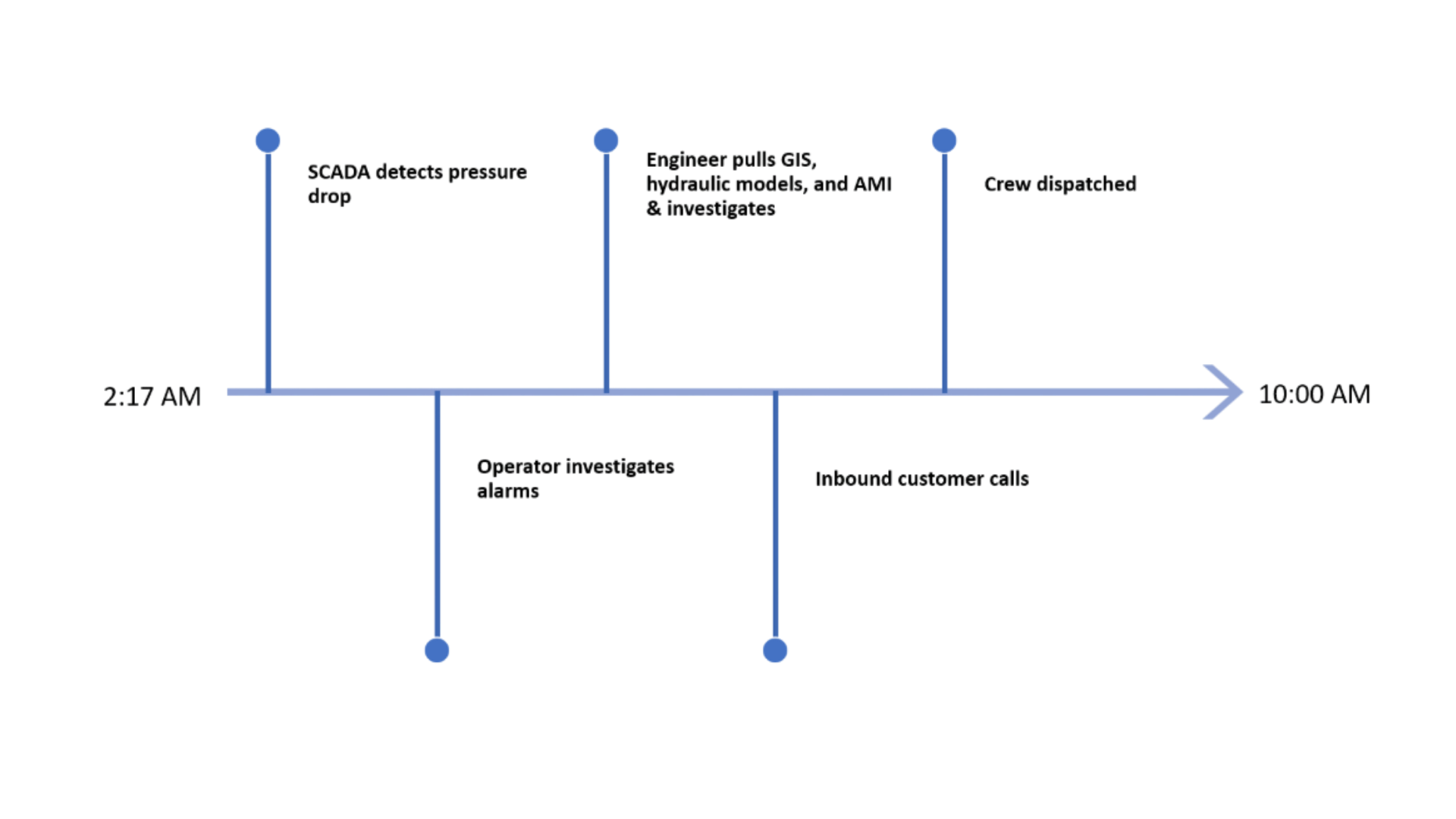
Agentic Response
An agentic system is built to transmit data across enterprise systems, then adds an analytical layer, kicked off by the detection of an anomalistic event, in this case a pressure drop in SCADA. The agents can be trained to understand hydraulic models, interpret water quality reads, and can correlate these data in order to infer the nature of the event, and the appropriate response, in this case to dispatch a crew of a certain size, with certain equipment, to a certain location.
Response under Agentic System
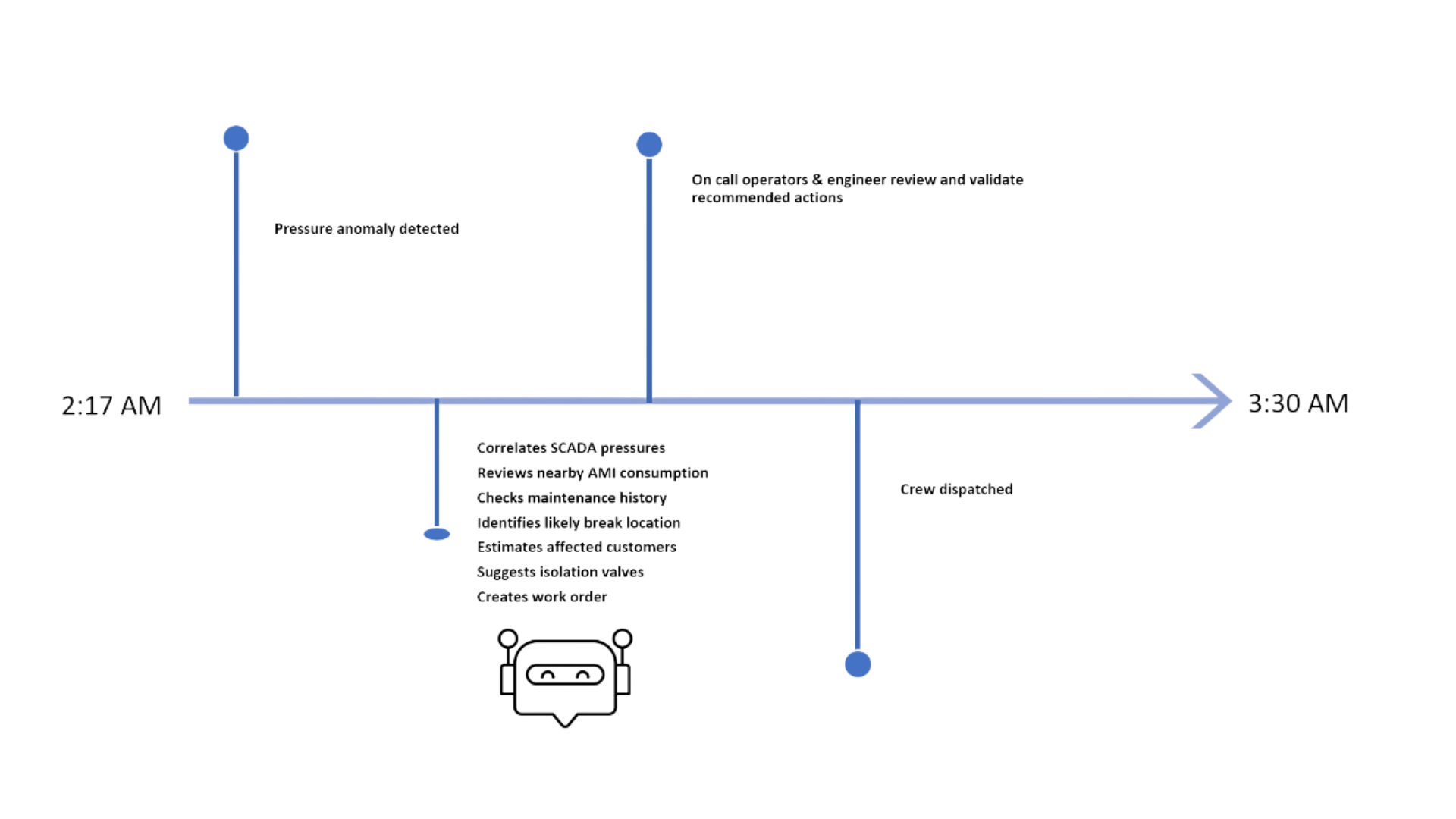
The most important shift that this represents is conceptual. Utilities have spent the last decade building systems designed to store, visualize, and govern data. Those capabilities remain important, but operational excellence is ultimately about managing events: leaks, breaks, overflows, contamination risks, storms, and customer outages. AI agents represent a new architectural layer that is not organized around data repositories, but around detecting, diagnosing, prioritizing, and responding to events. In that sense, agentic AI is not simply another analytics tool. This is a fundamentally different way of organizing utility operations.
Why Digital Leadership Matters
A thought on leadership
Most utilities are led by professionals whose expertise was developed in a physical infrastructure era. The next decade will require leadership that is equally comfortable discussing pumps and pipelines, as they are APIs and AI agents.
Utilities can start small and have their users drive the agentic tech for a while to see how it works, and if it solves the problem at hand. If it does, not every user needs to be able to decipher the code and the math. It's more important that the technology is secure and reliable, solves the problems and is user friendly, for that set of users (i.e. operators, engineering, emergency preparedness).
There are many problems to solve and utilities don't have money to deal with everything being thrown their way. Bringing new solutions to the table is critical for utilities to be able to maintain their current levels of service, within a given budget, for example extending useful life of infrastructure, avoiding pollution events, maintaining ops during storms and other emergencies, and communicating with customers. Also, tech savvy utility staff will certainly be playing around in the AI sandbox and even "vibe coding" solutions. So look to see internal & DIY AI-first use cases abound, in the short term.
The future isn't AI replacing SCADA or data lakes. The future is an event-centric operational layer built on top of them.